
Vocational education does more than prepare young people for the labour market, it also plays an important role in shaping engaged and responsible citizens. Yet in Thuringia, civic and political education within vocational education and training (VET) often received limited attention, as curricula tend to prioritise economic and professional skills. The project Civics in VET, in which Culture Goes Europe e.V. (CGE) takes part, seeks to address this imbalance by promoting democratic competence as an essential professional and life skill.
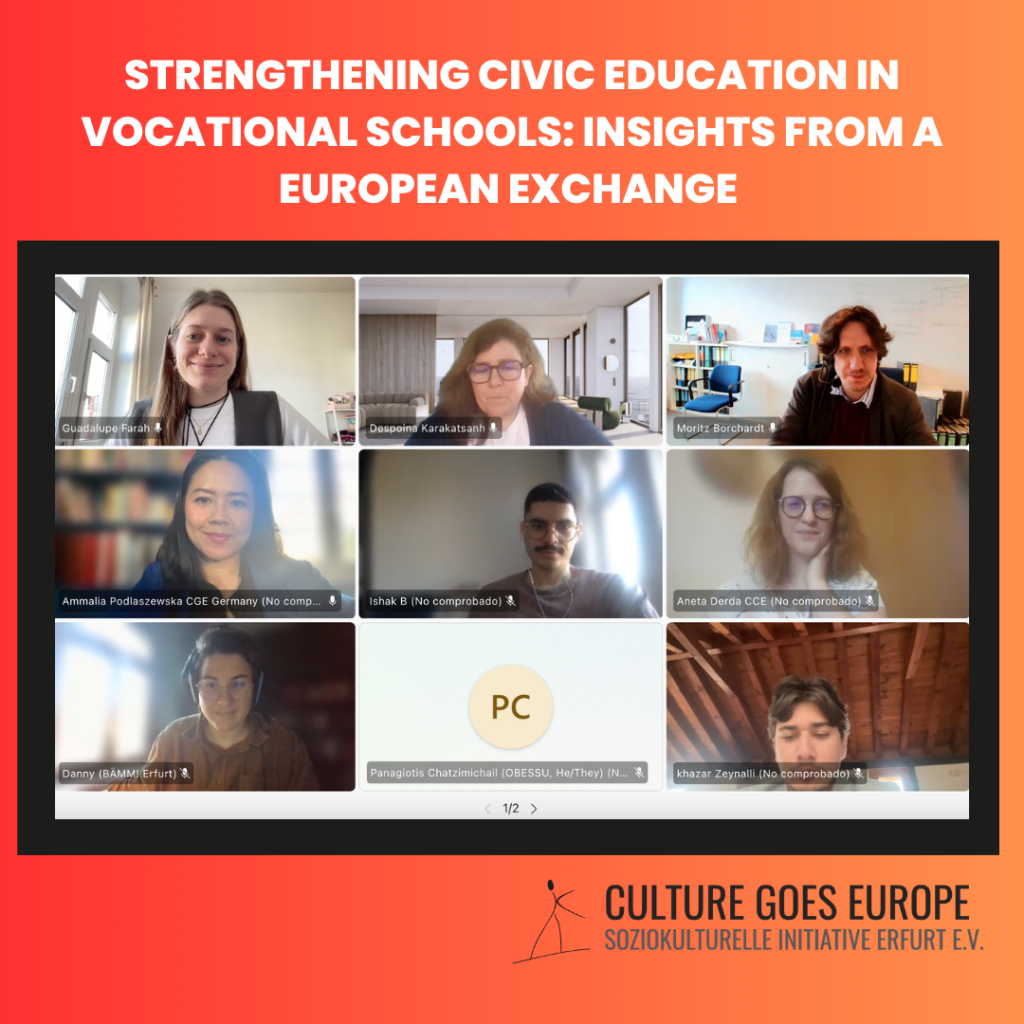
To explore this topic further and share the project’s findings, CGE co-hosted a webinar and networking event with the DARE Network on February 27th. The session brought together educators, youth workers, NGO representatives, and civil society actors from across Europe to discuss the intersection between civic education and vocational training. Using insights from two projects, Civics in VET (CGE) and CoCivic (KulturLife), the event created space for reflection on current challenges, good practices, and future directions for strengthening civic education in VET.
Dr. Ammalia Podlaszewska, chairwoman of CGE, opened the discussion by introducing the Civics in VET project. Its central idea is simple but ambitious: vocational schools should not only prepare students for labour market but also empower them to become active and thoughtful citizens in democratic societies. Research conducted with students, teachers, and youth workers revealed several important insights. Many vocational students care deeply about topics such as labour rights, anti-discrimination, and mental well-being. Yet many hesitate to express their political views in the classroom, fearing judgement or confrontation. They also often experience civic education as outdated or disconnected from their realities, calling for more practical and relevant learning approaches.
Teachers face similar constraints. Although they recognize the importance of civic education, they often lack time, resources, and institutional support, with many initiatives happening outside regular school hours. At the same time, cooperation between vocational schools and civil society actors remains fragile, often depending on individual contacts rather than stable partnerships.
During the webinar, Ana Guadalupe Farah, Project Coordinator at CGE, presented insights from the National Position Paper on civic education in Thuringia, a region that faces a double challenge: demographic change and a shortage of skilled workers are colliding with an increasingly polarized political landscape. Despite this, civic education remains marginal in everyday vocational school practice. The National Position Paper (link here) therefore proposes several policy recommendations aimed at strengthening the role of civic education in vocational schools, supporting teachers, modernizing pedagogical approaches, and fostering long-term cooperation between schools and civil society organizations.
The discussion also highlighted the work of the CoCivic project, presented by Moritz Borchardt. CoCivic connects vocational schools and civil society organizations in Germany, Turkey, and Spain, promoting project-based learning that links vocational skills with civic responsibility and community engagement. Through practical resources such as teaching frameworks, handbooks for civil society organizations, and mentoring programmes, the project supports educators in integrating democratic competencies into vocational training. You can find the resources and materials here.
The discussion highlighted that the challenges of civic education in vocational schools are shared across Europe. Participants emphasized the need for stronger partnerships between schools and civil society, better support and training for teachers, and learning approaches that connect civic competences with students’ everyday lives and future workplaces. The exchange also showed the value of international dialogue in identifying common challenges and inspiring new solutions. Through initiatives like Civics in VET and CoCIVIC, CGE and KulturLife continue to advocate for stronger civic education in vocational schools, recognizing that empowering vocational students with democratic competences is not only an educational priority, but also an investment in resilient democracies and cohesive societies.
