
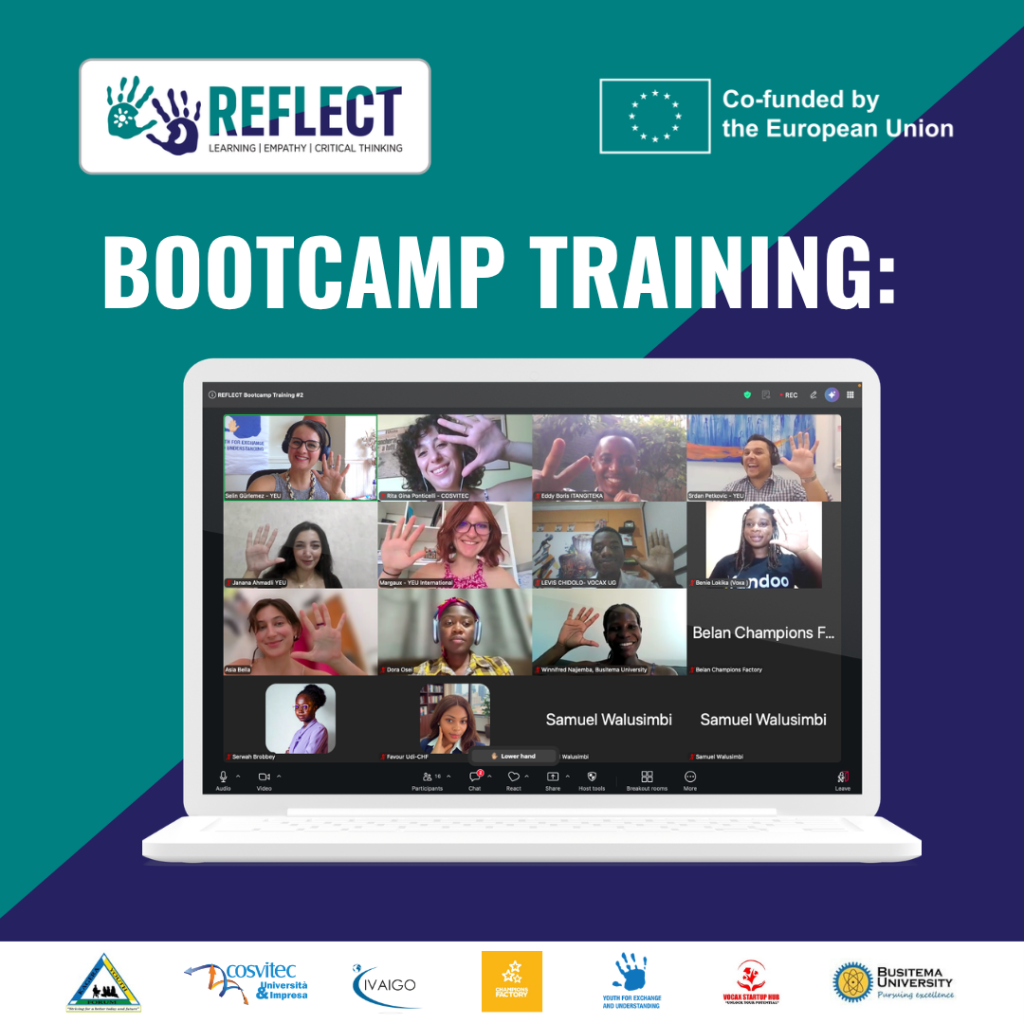
The REFLECT Facilitators Bootcamp is now halfway through, bringing together 21 facilitators from partner organisations across Belgium, Italy, Lithuania, Uganda, Ghana, and Tanzania.
REFLECT – Refugee-Led Exchanges for Learning, Empathy, and Critical Thinking – is a three-year Erasmus+ Virtual Exchange project that promotes intercultural dialogue, digital inclusion, media literacy, and employability through online exchanges connecting young people across Europe and Sub-Saharan Africa, with a particular focus on refugees and marginalized youth.
As part of the project, the online training is preparing facilitators to lead engaging and inclusive virtual exchanges for young people.
The Bootcamp training is led by YEU facilitator and PET Co-coordinator Srdjan Petković as a main facilitator, with the support of the YEU PET co-facilitator Janana Ahmadli.
Over the past four sessions, participants have explored the foundations of the REFLECT project, strengthened their online facilitation skills, and discovered practical methods and digital tools for creating interactive learning experiences. They also learned how to select the most suitable facilitation techniques based on different learning objectives and group needs.
The highlight so far came during the fourth and fifth sessions, when facilitators stepped into the lead role themselves. Working in groups within their own organisations, they designed and delivered practice webinars on topics connected to the REFLECT themes. This hands-on exercise gave participants the opportunity to put their newly acquired skills into practice, receive constructive feedback, and build confidence ahead of the project’s upcoming virtual exchanges.
With the second half of the Bootcamp still to come, facilitators will continue developing the knowledge and competencies needed to foster intercultural dialogue, critical thinking, digital inclusion, and youth participation.
The REFLECT Bootcamp is laying the foundations for meaningful online exchanges that will connect young people across Europe and Sub-Saharan Africa, creating safe spaces for learning, dialogue, and collaboration across borders.
