
Have you ever benefited from an Erasmus+ grant?
If so, we need your support and attention.
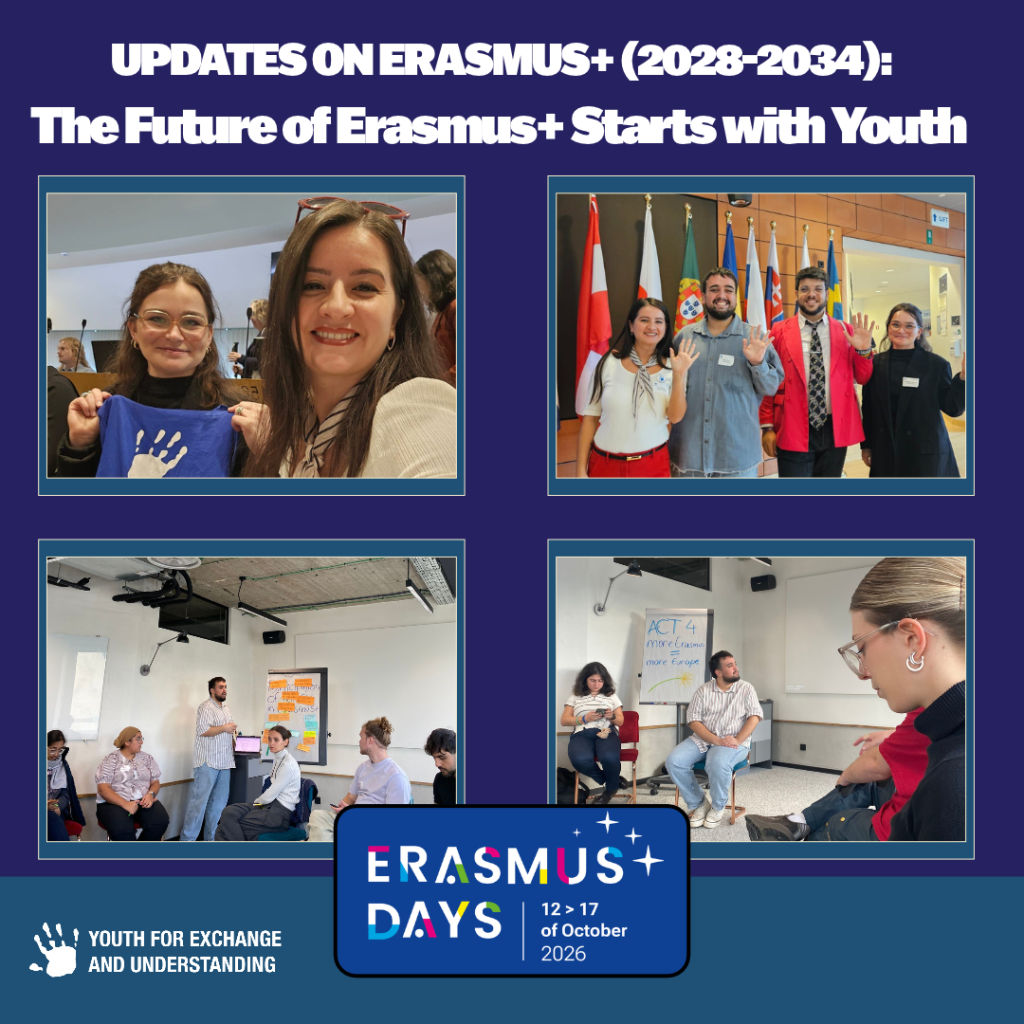
On October 16th and 17th, the European Youth Forum (YFJ) invited over 130 representatives from the youth field to engage with decision-makers in European Institutions around the Erasmus+ budget and regulation in an event they called “The Future of Erasmus+ Starts with Youth.” YEU was honoured to represent the network and advocate for a sustained, replenished, and inclusive Erasmus+!
Why now?
This autumn marks the final stages of negotiations around the Multiannual Financial Framework (MFF), the long-term European Union (EU) budget, which includes Erasmus+. As policymakers establish budget lines for 2028-2034, advocates in the youth field have continued to demonstrate the positive impact of initiatives funded under the Erasmus+ programme.
The campaign “More Erasmus = More Europe,” launched by YFJ over a year and a half ago, was supported by different policymakers and disseminated by many youth organisations. With these sustained efforts, the European Parliament’s draft proposal suggests a budget of 47.4 billion EUR, an increase from the initial proposal made by the European Commission.
Despite support from varied representatives across the political spectrum and a widespread understanding that Erasmus+ is a flagship programme of the EU – allowing for the creation of a European sense of belonging in younger citizens, the strengthening of soft and adaptable skills, and an overall more resilient democratic union- the budget is in danger of being reduced.
In the coming few months, the European Council (composed of Member States’ Ministers) will produce its final MFF and Erasmus+ proposal. From our partners’ echoes, some Member States will likely favour a decrease in the Erasmus+ budget.
Youth field actors must come together and act fast.
What was discussed during the event?
The conference opened with keynote speeches from Commissioner Glenn Micallef, YFJ’s President Caillum Hedderman and Roberto Pella, Committee of Regions’ rapporteur on Erasmus+. All three addresses highlighted the dedication and commitment of youth organisations, National Youth Councils and young people across Europe in the fight for a better, more inclusive future.
The next sessions encouraged dialogue and constructive exchanges between representatives of different sectors of European institutions and delegates around the upcoming changes, expectations and concerns about the Erasmus+ regulation.
Over the two days, our Secretary General, Selin, one of our Project Assistants, Lisa, and our Advocacy Volunteer, Clémentine, exchanged with stakeholders and peers around our shared goal for a stronger civil society sphere. Beyond the formal discussions, YEU representatives also had the opportunity to exchange perspectives and experiences with representatives of other International Non-Governmental Youth Organisations (INGYOs), National Youth Councils (NYCs) and European institutions. These exchanges highlighted our shared commitment to strengthening youth participation, supporting civil society and advocating for a more inclusive, accessible and well-funded Erasmus+ programme. It became clear that youth actors are united in their demands to the European Institutions.
What now?
The final part of the conference let delegates co-create advocacy campaigns targeting a specific aspect of Erasmus+ regulation to better reflect the reality of youth organisations.
Participants in “The Future of Erasmus+ starts with Youth” learned the importance of standing together to create a meaningful impact on policy.
As part of the Erasmus+ Coalition, we will continue to reach out to relevant decision-makers to make our demands heard. We encourage you to join us in the campaign to safeguard Erasmus+.
Importantly, we will keep asking the Finance and Foreign Affairs Ministries to:
- Irrespective of how the next EU budget will be allocated, Erasmus+ must be kept at least at 47.4 billion EUR.
- The Erasmus+ budget only represents 2%* of the total budget, despite being one of the most important for the sustainability of the Union. If all EU budget lines are up for discussion, do not cut the 2% that actually ensures that our citizens and countries are able to understand and address these challenges. Maintain Erasmus+ at 47.4 billion EUR to ensure Europe has the tools to stand up to global crises
*for more information on the campaign and how you can support the coalition, click here!
If you are part of one of our Member Organisations, be sure to follow up with our email on how you can help!
