
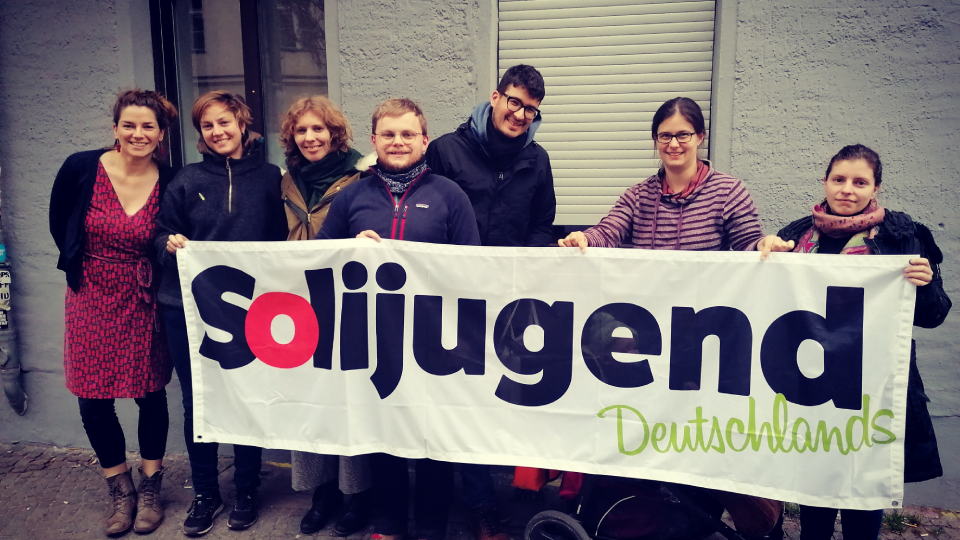
First, we would like to give you a warm welcome to the YEU Family!
Could you tell us the story behind your organization’s name and how it all started for you?
In the year 1930, the Arbeiter Rad- und Kraftfahrerbund “Solidarität” (Workers’ Cycling and Motor Federation `Solidarity`, ARKB, later just RKB) had become the largest cycling federation in the world. However, after the takeover of the Nazi Regime three years later, the ARKB was banned. This was followed by the dismantling of the federation and, in the course of this, the arrest and placement in prisons and concentration camps of an unknown number of officials and members. In addition, the association’s assets and all its property were confiscated.
After the end of the Second World War, former members campaigned for the reconstruction of the ARKB Solidarität. On 1st July 1949, the first parliament was held with participants from associations in the US and British zones. The French occupiers forbade participation because of the “communist” name “Solidarity” in view of the beginning Cold War. However, the youth was fully integrated into the adult federation. They had to clarify their decisions with the executive committees as the older functionaries had just a little respect of an independent youth. Also, financially the youth was dependent on the adults.
In August 1954, the Solidarity Youth became an independent youth organisation with the adoption of its own guidelines by over 100 youth leaders. This was recognised one year later at the ARKB’s national conference. In 1956, on the occasion of the 60th anniversary of the ARKB, the Solijugend organised a youth camp for the first time with 200 participants. On 20 April 1963, the Solijugend was accepted into the German Federal Youth Council (DBJR). A short time later, the federal office moved to Offenbach am Main, where it can still be found today.
In the same year, the Solijugend took part in the international bike, motorbike and car rally in Rosenheim. This inspired Karl Zeifang, former youth leader, to become involved in international activities. Two years later, in 1965, the first international youth meetings took place. At that time, the 79 participants from the FRG, Austria and Switzerland met in Kirchheim/Teck. The youth camp was continued over the years and expanded through contacts with other associations in Europe and North African countries as well. Despite the Cold War, young people from the CSSR also took part from 1968 onwards, which enabled an exchange of youth from both blocs. In 1972, the eighth Youth encounter took place on the Olympic Games in Ismaning, where 500 participating young people spent 24 days with and around the Olympic Games. On the ninth Federal Youth Congress in 1976, the guidelines and the basic program of the Solijugend passed, defining the youth political standpoint.
The NATO double decision and the resulting decision to station nuclear missiles in Western Europe gave rise to a peace movement in the FRG, which the Solijugend joined.
In 1985, the Solijugend organised its first Whitsun meeting with 200 participants.
Thanks to Michael Gorbachev and his glasnost and perestroika, young people from the USSR were able to attend a Solijugend event for the first time in 1985. Two years later, Erich Honecker and Helmut Kohl signed several GDR-FDR (East-West German) agreements. This rapprochement enabled the Solijugend to establish contact with the FDJ. In this context, the Solijugend visited the FDJ in the GDR in March 1987 with Bernd Schwinn, who was the federal youth leader at the time. Finally, they signed a joint communiqué. A GDR-FDR youth exchange was also planned, which was then able to take place.
The fall of the Berlin Wall and the subsequent end of the Cold War brought the opportunity to expand the Solijugend into the East. It was also possible to organise exchanges with former Eastern bloc countries, especially Russia. During the visit to Russia in 1991, some Solijugend members were involuntarily caught up in the August coup, in which Communist Party functionaries tried to depose Mikhail Gorbachev.
Until today, the Solijugend continues its involvement in the DBJR, the international youth meetings and numerous exchange programs. In addition, new partner organisations have been found, for example in Tunisia, Slovenia, Kosovo and France. In 2019, our 55th International Youth Meetings already took place in Regenstauf and in 2020 online with over 100 participants due to the international Corona Pandemic.
For other Member Organisations know you better and see how we can all work together in the upcoming years, could you tell us which is your mission? Could you also tell us some exciting projects and what kind of knowledge or expertise you could offer to YEU Members?
The Solidarity Youth of Germany, founded in 1954 as part of its umbrella organization “RKB Solidarität 1896 e.V”, has emerged as an independent Youth organization of the RKB. The “Solijugend” stands for a socially equitable, democratic and sustainable worldview. As a federal association, the Solijugend is structured within regional, state and national levels. It represents the interests of its members towards politics and the public. The highest body at the federal level is the Federal Youth Congress, which convenes all three years. As a nationwide youth association, the Solijugend is primarily involved in international youth work, non-formal education and leisure sports.
Through its active membership in the German Federal Youth Council (DBJR), it participates in developments in current youth policies. In the annual international youth meetings, it combines tradition and many years of experience in international youth work with new concepts. Have a look at our latest image video: https://www.youtube.com/watch?v=q5T0RJizX7o .
For more than 56 years, the Solidarity Youth of Germany has been organizing and hosting national and international youth exchanges. It maintains partnerships with youth organizations in the European Union (Ireland, France, Netherlands, Poland, Slovakia, Slovenia, Czech Republic), in Russia and in North Africa (Algeria, Morocco, Tunisia). It is the only youth association, which offers a regular youth exchange with Algeria.
In the last 6 years, Solijugend implemented a joint project with its partners from Slovenia and Kosovo in the trinational project “Trialog 4.0”: http://www.solijugend-bayern.de/aktivitaten-3/projekt-trialog/ .
In 2020, Solijugend successfully realized the online project “Global Education – Digital Youth Work Project” together with its Turkish partner GSM: https://globaleducation-online.org/ about topics like intercultural learning, global citizenship, gender and sustainability.
The education officers from Solijugend have many years of experience in conducting seminars, in implementing youth leader trainings (Juleica), implementing and accompanying pre-, intermediate and follow-up seminars for voluntary service in Europe and worldwide. Its main office and training center are located in Offenbach (near Frankfurt/Main). Furthermore, Solijugend has another office in Berlin where the officer for international relations works.
YEU members are very welcome to contact us via this e-mail: bgst@solijugend.de
As an organisation, how would you describe the improvement of young people´s lives through your projects?
As an independent federal association, we use our annual international youth meetings to facilitate intercultural, interpersonal and interreligious encounters between young people, including disadvantaged people, at home and abroad. We continuously improve these projects and multilateral workshops by creative and inclusive activities, discussions, cooperation games, theatre methods, experiential non-formal education and a sports and leisure program. Through this mixture of offerings, we counteract prejudices, racism and violence and can contribute to international understanding and international cooperation of young people.
Furthermore, we give young people the opportunity to:
- initiate contacts
- develop self-confidence and self-assurance
- train themselves physically and mentally
- try out new forms of communication
- express and represent needs and concerns
- learn to deal with criticism
- develop conflict management skills
- become aware of their own views and behaviour
- develop tolerance of ambiguity and empathy
- reflect on themselves and others
YEU network is a one-big-YEU-family where we all share good and bad moments, interesting projects and experiences. Since you are becoming a member, could you tell us your biggest challenges during 2020 and how you managed?
2020 we implemented our international youth encounters, which Solijugend is implementing for 56 years, for the first time online. This was quite challenging, as we had to switch almost all our seminars and workshops to online and therefore change all formats and train ourselves with new methods. From the beginning of the first “wave” in March, we tried to be creative and positive. Furthermore, we supported each other being in regular contact with our partner organisations. We, therefore, established a nice culture of online-communication, which was necessary in order to implement a full online-program for five days.
We would also love you to share some beautiful and happy moment your organisations has lived.
As a beautiful moment in 2020, we could describe our power of being creative, innovative and cooperative together with our partners. We managed to do a 5 days online encounter with 100 participants from nine countries and involve everyone in the preparation, so at the end we had an amazing feeling of working together from different parts of the world.
Furthermore, we translated the workshops and discussions into six different languages (English, French, Czech, Russian, Arabic and Turkish) so that participants still could speak in their mother tongue. Additionally, members of Solijugend and our partners very happy and proud that we switched to online tools and had not to cancel the encounters.
A beautiful and a sad moment at the same time is the farewell on Saturday evenings at our youth encounters when everyone holds hands in a big circle and sings “Leaving On A Jet Plane” by John Denver which we sing every year at the end of the encounters. On the one hand, this is a very sad moment, as you have to say goodbye to each other, on the other hand, you look forward to the next international youth encounters, where you will see each other again.
For the end, can you tell us what are your expectations from YEU and its member organisations and in which area you see YEU network supporting you in achieving your goals?
We are very much looking forward to a large network of interesting YEU member organisations and:
- to exchanging practical experiences regarding the implementation of projects, the voluntary services and online seminars and workshops,
- to taking part in trainings,
- supporting each other,
- to exciting discussions,
- to participate in the “Coffee with” events,
- and experiencing diversity.
Furthermore, we are interested in joint projects with other youth organisations and open for exchange. In particular, we are interested in finding new Partners from Greece, Spain, Italy and Lithuania for our international youth encounters.
