
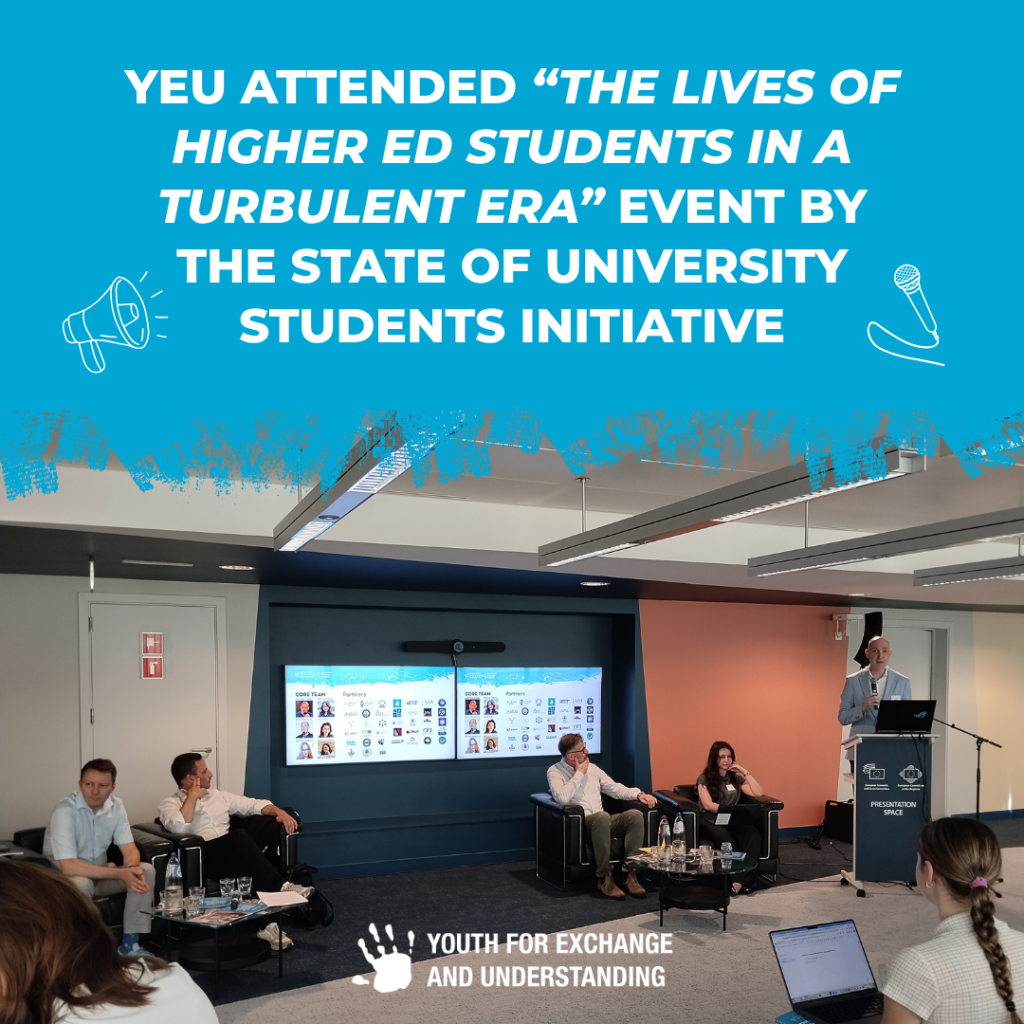
On June 25, YEU attended an event at the European Economic and Social Committee* organised by two Romanian organisations promoting civic engagement in higher education and democratic resilience.
The event presented “The State of University Students: The Lives of Higher Ed Students in a Turbulent Era,” a national-scale study on university students’ life quality in Romania. As Emil Mesaroș, the host of the event, pointed out, this conversation was not meant to discuss the national context merely, but to show that all across Europe young people and students are facing similar challenges – albeit with different degrees of severity.
Following the insightful presentation of results, three influential Romanian Members of the European Parliament (MEPs) from different political groups discussed their takeaways and avenues for solutions.
The major societal problems underlying the “state of university students” were identified as housing affordability, mental health and addictions as public health concerns and the uncertain prospect of employment in the age of AI, by European Parliament Vice-Presidents Nicolae Ștefănuță and Victor Negrescu, and a co-chair of the EPP political group, Siegfried Mureșan. Despite the different political affiliations of the guest speakers, the debates centred on concerns for young people’s well-being and future opportunities.
Importantly, all three MEPs praised the important role that Erasmus+ has in providing youth with opportunities and new horizons. On the other hand, they also stressed that Erasmus+ programmes remain too expensive for many students and young people, despite the scholarships offered to some. As the MFF negotiations are coming to an end (with a final vote set for the autumn), this event was an important reminder of why we should fight to defend and increase the Erasmus+ budget line.
Erasmus+ makes youth resilient, provides different opportunities and fosters a sense of belonging, which helps mitigate the increasing feelings of loneliness, depression and the reality of employment exclusion, which the study highlighted. The programme needs to include youth with fewer financial means to enhance Europe’s tomorrow.
*Note: The European Economic and Social Committee is the consultative body of the European Union: gathering experts’ opinions and fostering civil society partnerships, it provides (non-binding) advice to improve EU policies.
