
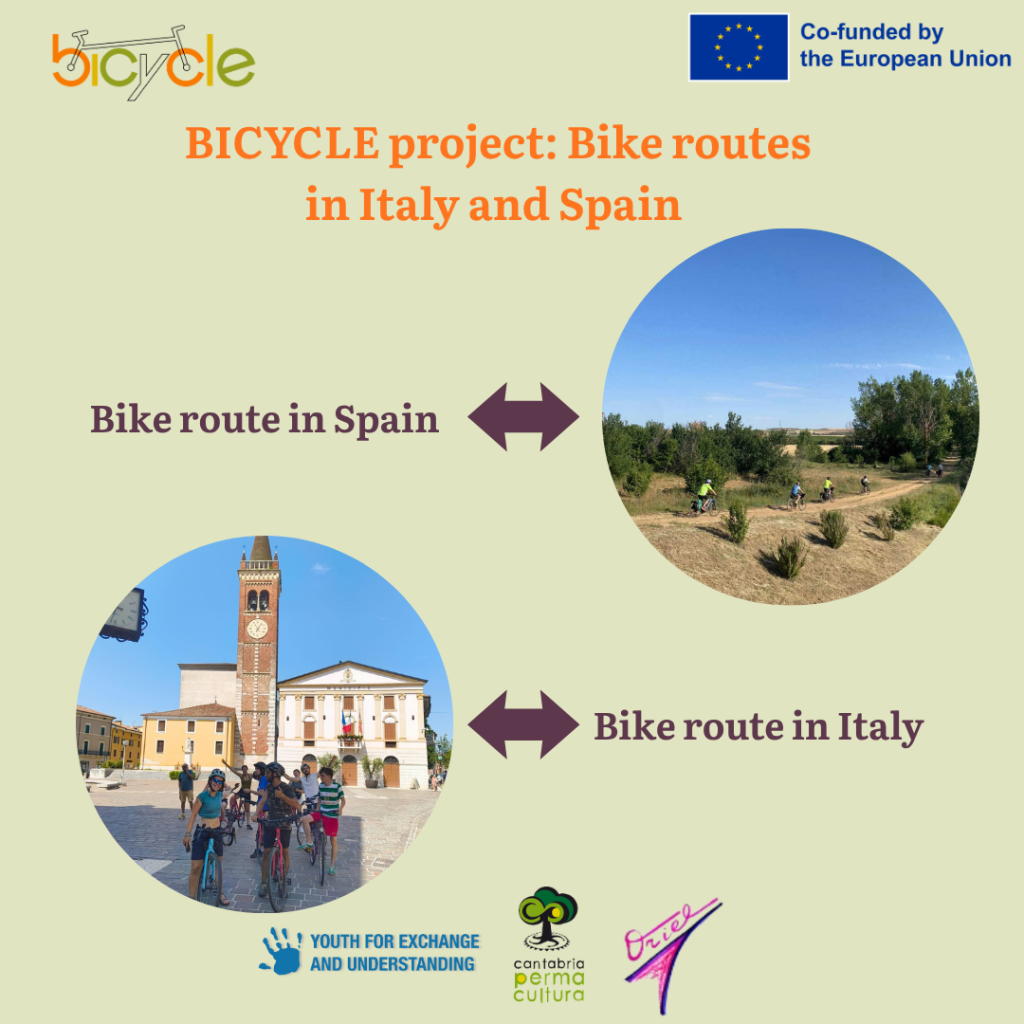
Across Europe, the BICYCLE project- Bicycle Culture as Youth’s Civic and Sustainable Empowerment, an ERASMUS+ project, continues to show how cycling can bring people together, open conversations about sustainability and create stronger links between young people, communities and local territories.
In June and July 2026, Bike Routes activities took place in Spain and Italy, offering participants the chance to experience cycling not only as a means of transport, but also as a tool for learning, participation and community connection.
Spain
In Spain, Permacultura Cantabria organised a series of Bike Routes in collaboration with local partners and cycling stakeholders. The first route connected El Astillero and Sarón, bringing together 21 participants for a practical outdoor activity focused on sustainable mobility, cycling culture and active citizenship. Participants cycled between urban and peri-urban areas, observed local cycling infrastructure and discussed topics such as safety, accessibility, road maintenance, respect between cyclists and drivers, and the role of local authorities in promoting cycling. The activity also created a space for dialogue between citizens, cycling organisations and public representatives, showing how practical cycling experiences can support better conversations on mobility and public space.
The Spanish Bike Routes continued with a second weekend along the Canal de Castilla and Tierra de Campos, where participants explored the connection between cycling, cultural heritage and sustainable tourism. The route followed historic canal infrastructure and passed through several towns and villages, including Becerril de Campos, Belmonte de Campos and Medina de Rioseco. Participants visited heritage sites such as medieval castles and reflected on how cycling can offer a slower, more respectful and more immersive way to discover local history, rural landscapes and cultural heritage.
A third Spanish activity took participants to the Vía Verde del Pas, one of Cantabria’s greenways created from former railway infrastructure. The activity combined a workshop, practical cycling preparation and a guided route from Sarón towards Puente Viesgo. Participants learned about bicycle adjustment, basic maintenance, safe group riding and the reuse of former transport corridors for cycling, walking, sustainable tourism and rural development. The route was adapted to the pace and abilities of the group, reflecting the inclusive spirit of the BICYCLE project.
Italy
In Italy, Oriel APS organised the BICYCLE Bike Routes activity in Verona over two weekends, from 19 to 21 June and from 27 to 29 June 2026. The activity promoted sustainable mobility, youth participation and stronger community connections through cycling.
During the first weekend, participants cycled from Porta Nuova in Verona, staying overnight in Valeggio and Pazzon. Along the way, they also had time to enjoy Fontanín, a small natural pool near Valeggio, where they could relax and cool down. The second weekend followed a similar route, starting from Villafranca di Verona, passing through Custoza, staying in Fontanafredda, continuing to Bussolengo and making a short stop in Pacengo to refresh by the lake. The routes covered around 25 to 30 km per day.
The Italian activity brought together participants of different ages and cycling abilities. Everyone was encouraged to ride at their own pace and respect their own limits, creating an inclusive and supportive atmosphere. With the support of the Oriel team, participants also had access to energy bars and fresh drinks, which helped them stay hydrated during the summer heatwave.
Along the routes, participants explored local cycling paths, exchanged ideas on sustainable mobility, learned basic bicycle maintenance and strengthened their connections through teamwork and intercultural exchange. The activity showed how cycling can create shared experiences while encouraging reflection on healthier, greener and more connected ways of living.
Together, the Bike Routes in Spain and Italy highlighted the many dimensions of cycling: active mobility, environmental responsibility, heritage discovery, local development, inclusion and civic participation. Whether through greenways, rural landscapes, cultural routes or community rides, participants had the opportunity to experience cycling as a practical and meaningful way to engage with the places around them.
Stay tuned to discover the Bike Routes in other countries.
