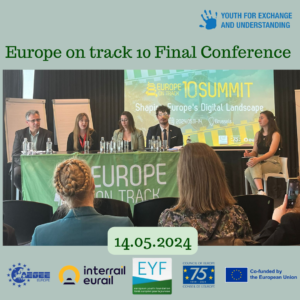
On the 14th of May, our Membership & Communication Officer Chiara Veronese joined the the conference organized in Brussels by AEGEE-Europe, in the framework of the 10th edition of AEGEE-Europe’s Europe on Track project, Digital Voices, European Choices: Youth Impacting Tomorrow.
The Project, co-founded by the European Youth Foundation, revolves around youth empowerment in navigating the digital landscape and being active participants in shaping Europe’s digital future. Furthermore, the project focuses on AI’s role in fostering democratic participation, especially in the light of the upcoming European elections.
As part of the project objectives, the conference intended to create rooms for debating and sharing opinions. Indeed, , the conference gathered young people, together with academia policymakers and press representatives with the scope of getting youth closer to decision makers and giving voice to their needs and ideas.
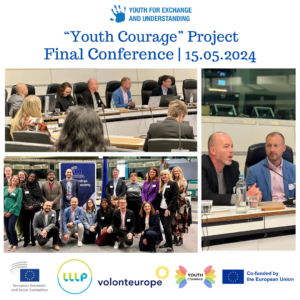
The day after, Alba Zecca, YEU Project Assistant, attended the Youth Courage Project final conference, which was held at the European Economic and Social Committee, in the frame of the European Mental Health Week.
The Youth Courage project, funded by Erasmus+, focused on marginalised groups of young people who lack access to support resources. Its primary objective was to support and reintegrate these individuals while equipping youth work professionals with the necessary tools to ensure the mental well-being of young people across Europe.
The conference brought together representatives from partner organisations, including Volonteurope (Belgium), Jugend Am Werk (Austria), Verein Auxilium (Austria), Vol.To ETS (Italy), Meath Partnership, LLP (Belgium), and Learning for Wellbeing Foundation (Belgium), alongside members of the ECSC. Two panels were convened: one discussing “Lessons Learned from the Youth Courage Project” and the other focusing on “Mental Well-being of Young People, an Emerging Issue Across the EU”.
As part of the project results, a survey had been created and distributed by the partners to report the difficulties faced by marginalised youth in the involved countries. They revealed the strong connection between mental health and various aspects of daily life, including education, social media usage, smartphone dependency, as well as the impact of economic and educational disparities and environmental crises. These factors contribute to feelings of anger and anxiety among young people, hindering their ability to take meaningful action. For this reason, there is a need to co-create tailored activities within schools, engaging young people directly and addressing their needs and concerns. Furthermore, it is essential to raise awareness about the importance of mental well-being and to advocate for policies that prioritize the well-being of young individuals.