
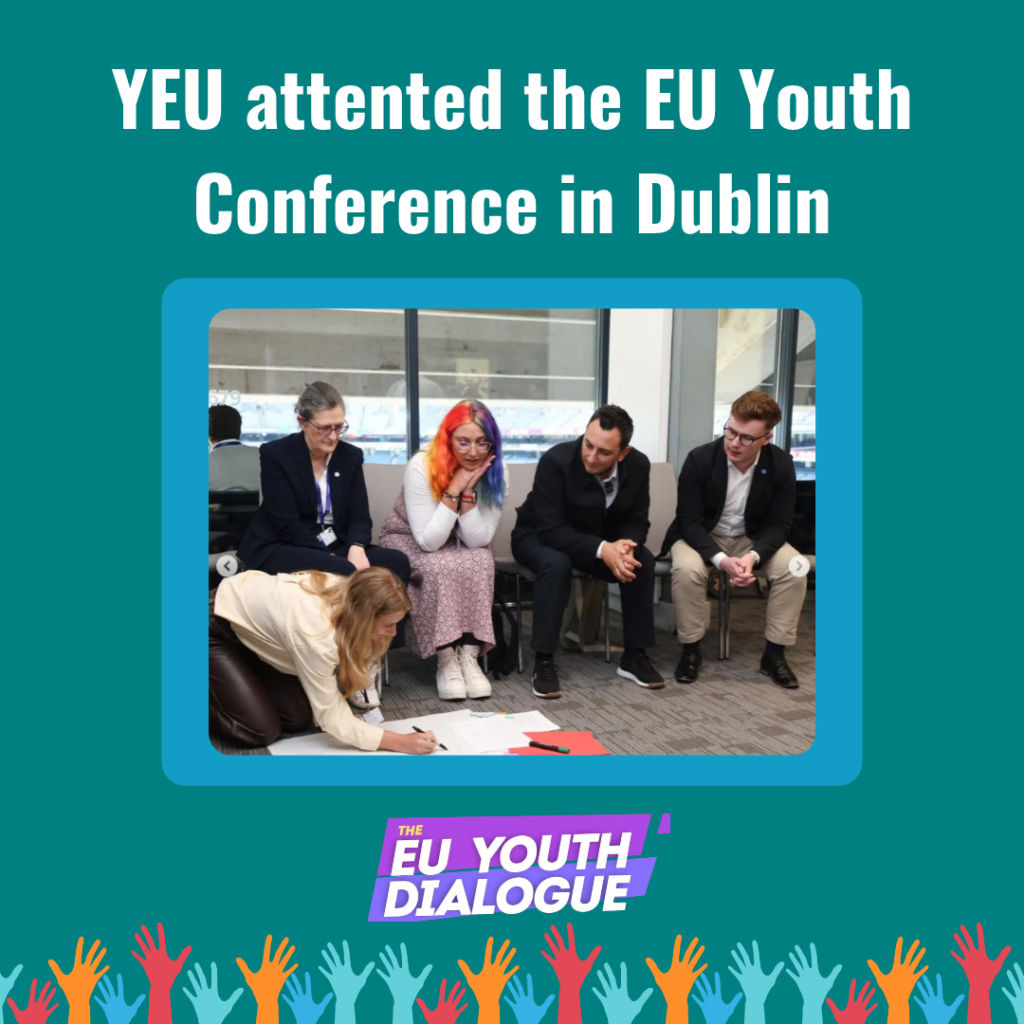
Between September 27th and 30th, YEU took part in the EU Youth Conference in Dublin. Represented by our President, Yağmur Aşıla, YEU joined youth delegates, National Youth Councils, international non-governmental youth organisations (INGYOs), and European decision-makers to contribute to the 12th cycle of the EU Youth Dialogue.
Centered on European Youth Goal #4: “Information and Constructive Dialogue,” the conference addressed urgent challenges surrounding democratic engagement, reliable information, and the necessity of building trusted, inclusive spaces where young people can directly shape European policy.
Updating Priorities & Revising the European Youth Goals
A major goal of this conference was to establish the foundations for European youth policy, particularly in the lead-up to the post-2027 EU Youth Strategy.
Delegates engaged in comprehensive review sessions to assess the relevance of the current framework from their different perspectives. Discussions focused on updating existing targets to reflect emerging realities such as digital transformations, climate justice, and shrinking civic spaces, as well as formulating proposals for the revision and next generation of European Youth Goals.
YEU actively took part in Working Group 5: “Inclusive Youth Participation and Trusted Spaces,” aiming to bring grassroots perspectives of our Member Organisations to decision-makers. The group strongly emphasized that inclusion must go far beyond physical accessibility: policy frameworks must break out of conventional structures to reach youth who are consistently left behind.
High-Level Exchanges with Decision-Makers
A notable highlight was a direct and honest conversation with Glenn Micaleff, European Commissioner for Intergenerational Fairness, Youth, Culture, and Sport during the Working Group session.
Youth representatives highlighted the critical need for institutional accountability, stressing that consultations must be coupled with concrete mechanisms to ensure youth perspectives genuinely impact EU legislation across all sectors.
YEU also engaged closely with European Youth Forum leadership. We connected with Caillum Hedderman (President of the European Youth Forum) as well as Board Members Maria Markkula (Board Member for EU Youth Policy and Youth Participation, who delivered the conference opening speech) and Marin Capan (Board Member for Youth Mainstreaming in the EU & Recognition of youth organisations) to align joint advocacy priorities across pan-European platforms.
Walking the Talk: Inclusion Must Start at the Door
While the policy outcomes were rich and collaborative, the conference also brought systemic administrative hurdles to the surface. Discussions surrounding “inclusive youth participation” lose their integrity when the logistical frameworks of European youth events create barriers rather than bridging them.
When European platforms invite non-EU National Youth Councils and pan-European INGYOs, organisations whose leadership and delegates frequently come from non-EU countries, visa facilitation must be treated as an essential structural priority. Lengthy administrative procedures and delays in invitation letters undermine delegates’ ability to secure appointments on time.
Furthermore, true socioeconomic inclusion requires visa application fees and associated travel costs to be systematically covered and reimbursed. Expecting youth delegates or youth-led NGOs to absorb high visa costs places an unfair burden on those already facing systemic barriers. Coupled with tight travel itineraries that forced several participants to depart before the final plenary presentations, these logistical realities demonstrate that European youth processes still have progress to make. We cannot afford to leave any young people behind, especially when gathered to champion inclusion and equality.
Next Steps
The inputs, revisions, and recommendations finalized in Dublin will directly inform the upcoming Council Conclusions under the Irish Presidency and set the course for subsequent phases of the 12th cycle. YEU will continue to ensure that international youth perspectives are heard loud and clear as the process moves forward.
Next stop: Lithuania!
