
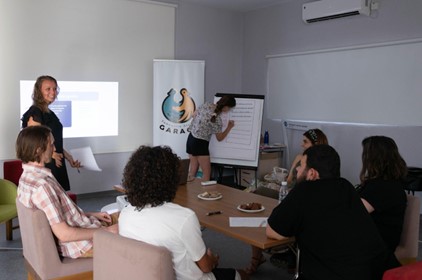
YEU Cyprus organized a focus group under the “Cap the Gap” European Solidarity Corps project. This one year project, run by volunteers from various European countries, aims to promote the inclusion of young, under-represented people and women in everyday decision-making processes. The focus group aimed at identifying the barriers and challenges faced by organizations that work with young people in the region of Famagusta and to further discuss the main problems faced on a daily basis.
From the beginning it was clear that the topics participants wanted to talk about the most were cooperation within organizations, lack of information amongst youngsters and budget issues. The political situation was also selected as an important topic to discuss, as well as the lack of initiative from the targeted population.
Regarding internal issues related to cooperation and collaboration within organizations, the group mentioned that there is a lack of understanding when it comes to designing events and activities that are targeted to different audiences, who have different needs. To combat this, they suggested NGOs adopt different strategies of promotion to target different groups of people from different contexts. Given that some people have special and practical needs that others don’t, organizers of events must take them into consideration.
External challenges were many, beginning with youth participation, more specifically the lack of interest of young people to get involved. Funding limitations were also mentioned, which significantly shorten the variety of available opportunities for youth in Famagusta. The role of seasonal changes was also debated, as there seems to be a high season during summer, due to tourism, which makes it more difficult for organizations to find venues for their events. But winter also brings complications, because of less financial availability from participants.
Overall, after all discussions had taken place, it was clear that one of the main issues facing NGOs in Famagusta is the little investment that is made into strengthening collaborations between each other. We also observed some challenges that are very specific to the Famagusta region as a less urban area, such as dealing with seasonal changes in availability of venues and funds, as well as managing and adapting to several different audiences.
This was a fruitful focus group in discussing already implemented solutions and also some strategies that could be applied in the future, such as contacting local radios and influencers or artists, in order to channel greater participation from young people, as well as the possibility of utilizing a third party mediator to vouch for smaller NGOs and facilitate collaborations, instead of competition.
